What Property Managers Actually Do for Short-Term Rentals in Japan
Table of Contents
A friend messaged me the other day asking about our property management page. His question was basically: “Wait — if I list on Airbnb, does it just… show up on Booking.com and Rakuten too?” The short answer is no, not automatically. But that’s exactly the kind of thing a property manager handles for you, and it’s one of the biggest reasons owners hire one.
If you own a property in Japan and you’re renting it out short-term — or thinking about it — here’s an honest breakdown of what a management company actually does day-to-day, and when it makes sense to hire one versus doing it yourself.
OTA = Online Travel Agency. Think Airbnb, Booking.com, Expedia, Rakuten Travel, Agoda — any platform where travelers search for and book accommodation online. Your listing on one OTA doesn’t automatically appear on the others. Getting your property listed across multiple OTAs (called “multi-channel distribution”) is one of the core things a property manager handles. More channels = more visibility = fewer empty nights.
The Multi-Channel Problem
Most owners start on Airbnb because it’s the easiest platform to get listed on. You create an account, upload some photos, write a description, set a price, and you’re live. Simple enough.
But Airbnb is just one channel. In Japan specifically, a huge chunk of bookings — especially from domestic travelers and guests from other parts of Asia — come through Booking.com, Rakuten Travel, Jalan, and Agoda. If you’re only on Airbnb, you’re invisible to all of those travelers.
The problem is that listing on multiple platforms creates real operational complexity. Here’s what it looks like when you try to manage everything yourself:
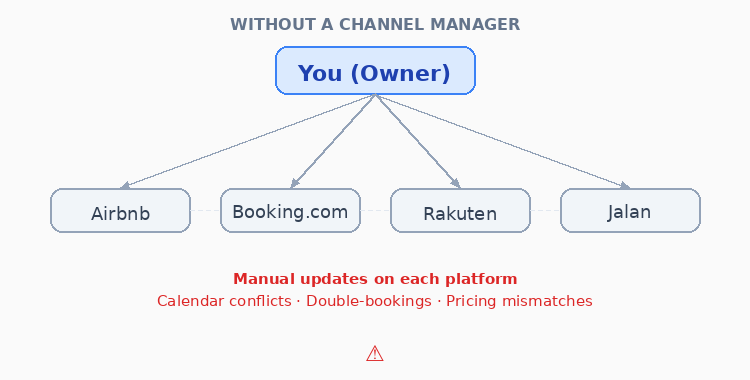
You’re logging into four dashboards, updating prices on each one, manually blocking dates when a booking comes in elsewhere, and keeping listings in sync across different languages and formats. One missed calendar update and you’re double-booked — cancelling on a guest, tanking your rating, and potentially paying a penalty.
This is where a channel manager (also called a site controller / サイトコントローラー) changes everything:
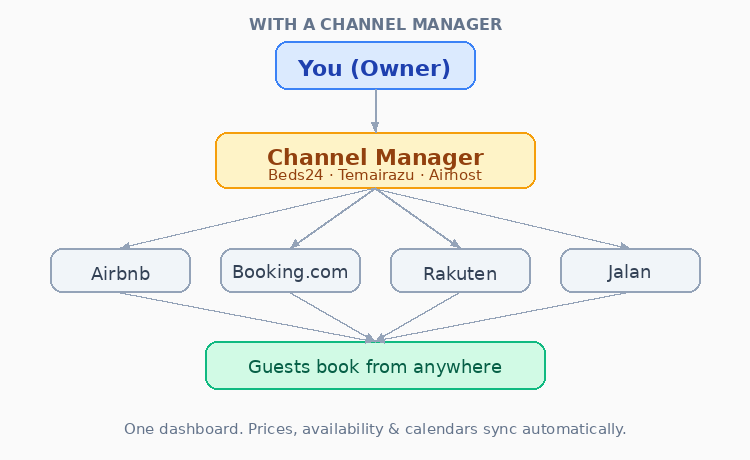
One dashboard. You update your price or block a date in one place, and it pushes to every connected OTA instantly. When a booking comes in on Rakuten, the dates are automatically blocked on Airbnb and Booking.com. No double-bookings.
When you hire a property manager, they run the channel manager for you — and handle all the platform relationships, content, and pricing on your behalf. That’s where the next diagram comes in:
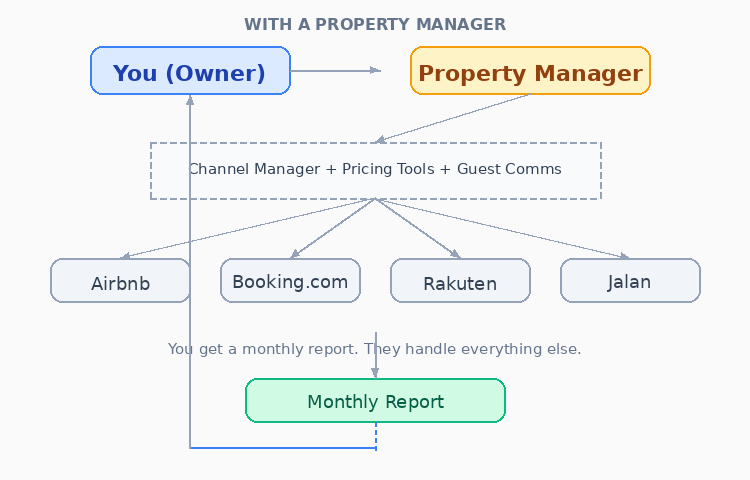
What a Property Manager Actually Handles
Beyond OTA distribution, here’s the full scope of what management companies typically cover in Japan:
Guest Communication
Every booking generates a stream of messages: pre-arrival questions, check-in instructions, mid-stay requests, post-checkout reviews. Across multiple platforms, in multiple languages, often at odd hours. Most management companies run this with a mix of templates, AI chatbots for common questions, and human escalation for anything complex.
Dynamic Pricing
Setting a flat rate year-round is the single biggest revenue mistake I see from self-managing owners. Japan’s demand is wildly seasonal — Golden Week, cherry blossom season, Kyoto in November — and the difference between a well-priced property and a static one can easily be 20–30% in annual revenue. Property managers use tools like PriceLabs or Beyond to adjust rates daily based on demand, competitor pricing, and local events.
Cleaning and Turnover
Every guest checkout triggers a turnover: cleaning, linen swap, amenity restock, damage check. In Japan, this typically runs ¥7,000–¥15,000 per turnover depending on property size. Management companies coordinate cleaning crews, manage linen supply, and handle the logistics so the property is guest-ready for same-day check-ins when needed.
Regulatory Compliance
This is the one that catches most foreign owners off guard. Japan’s short-term rental regulations are complex and city-specific:
- Minpaku (民泊) licensing — the national framework caps you at 180 nights per year unless you have a different license type. Some cities (Kyoto, parts of Tokyo) add further restrictions on top.
- Front desk requirements — Kyoto in particular requires face-to-face ID verification at a licensed front desk facility. You can’t just leave a lockbox and a PDF.
- Accommodation tax (宿泊税) — Tokyo, Osaka, Kyoto, Fukuoka, and a growing list of cities levy per-night taxes that someone needs to collect and remit. Some OTAs handle this automatically; others don’t.
- Fire safety, waste disposal, neighbor notifications — all real requirements that vary by municipality.
A management company that operates in your city already has these systems in place. For an overseas owner, this alone can justify the management fee.
Reporting and Settlement
Most managers provide monthly revenue reports with a breakdown: gross bookings, OTA commissions, cleaning costs, management fees, and your net payout. Good ones also include occupancy data and market benchmarks so you can see how your property is performing relative to comparables.
What It Costs
The standard model in Japan is a percentage of net revenue — typically 15–25%, with 20% being the most common. “Net” usually means after OTA commissions are deducted, so on a ¥100,000 gross month where the OTA takes ¥15,000, the manager’s 20% fee is calculated on the remaining ¥85,000 (= ¥17,000).
Cleaning is usually charged separately per turnover. Some companies also charge for front desk services where required by local regulation.
Is it worth it? That depends on your situation. If you’re overseas and can’t handle guest communication in Japanese, or if you don’t have cleaning staff lined up, or if you’re not confident navigating minpaku licensing — then yes, the 20% is buying you a functioning business rather than an empty property. If you’re local, speak the language, and only have one property, self-management is viable — but expect it to be a genuine part-time job, not passive income.
When Self-Management Makes Sense
To be fair, not everyone needs a property manager. You might be fine on your own if:
- You have one property in a city you live in
- You’re comfortable managing in Japanese (or your guests are primarily English-speaking)
- You’re willing to be on-call for guest issues
- You can handle or outsource cleaning reliably
- You’ve sorted out your own licensing and tax compliance
The moment you add a second property, move overseas, or just don’t want to deal with a 2 AM message about a broken air conditioner — that’s when the math shifts.
The Bigger Picture
The thing my friend didn’t realize — and that many first-time owners miss — is that listing a property is just the beginning. The real work is distribution, pricing, operations, and compliance, running continuously. A management company packages all of that into a single service so you get the rental income without the operational overhead.
Whether you self-manage or hire someone, the key is understanding what the work actually involves. Because “passive income from Airbnb” is one of the most misleading phrases in real estate — and in Japan, with its layered regulations and seasonal demand patterns, that’s doubly true.
This post is for informational purposes only and does not constitute business or financial advice. Regulations, commission structures, and service costs vary by city and provider. Please verify current requirements with local authorities and service providers.
Comments